How much mobile data you actually use in Japan
Travelers heading to Japan often overestimate Google Maps data usage and underestimate social media and train-ride streaming. In Tokyo, Osaka, and Kyoto, your phone stays busy all day: checking Shinkansen platforms, translating restaurant menus with Google Lens, tapping Tabelog reviews, and messaging friends on LINE or WhatsApp.
Yet pure text, maps, and translation are surprisingly lightweight. What actually pushes a Japan trip past 10 GB is uploading uncompressed travel videos on cellular, scrolling Instagram Reels or TikTok on long rides, and forgetting to pause cloud photo backups.
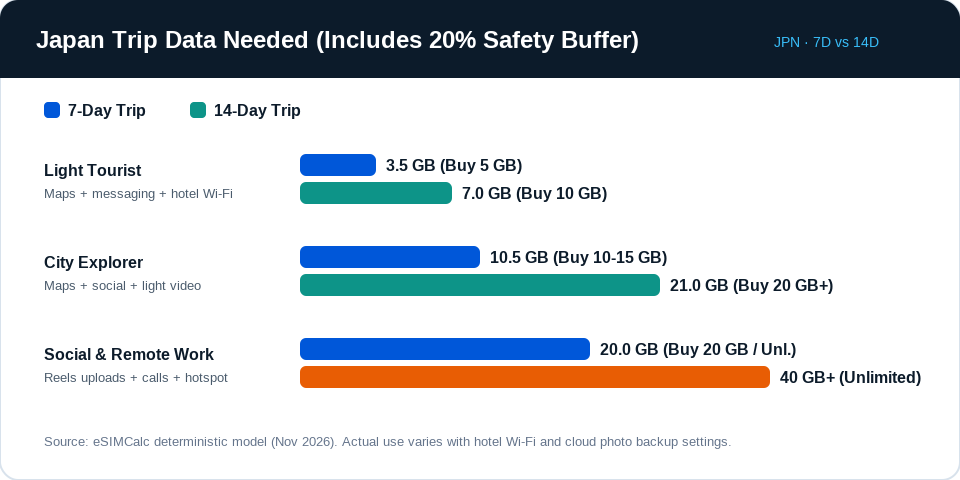
Recommended Japan eSIM gigabyte tiers by trip length
| Trip Length | Light Tourist (Maps + Chat) | City Explorer (Maps + Social + Reviews) | Heavy Social / Remote Work |
|---|---|---|---|
| 5–7 Days | 3 GB – 5 GB | 5 GB – 10 GB | 15 GB – 20 GB or Unlimited |
| 10–14 Days | 5 GB – 10 GB | 10 GB – 20 GB | 20 GB+ or Unlimited |
| 15–21 Days | 10 GB | 20 GB | 20 GB + Top-up or Unlimited |
Why 10 GB / 30 Days is the sweet spot for Japan
Japan is one of the most competitively priced travel eSIM markets globally. Whereas 10 GB in Canada or Europe can cost $29 to $37, a 10 GB / 30-day Japan eSIM typically costs $15 to $19 across major providers. Because the step-up from 5 GB ($11) to 10 GB ($16–$18) is only a few dollars, most 7-to-14-day travelers save stress by grabbing a 10 GB bucket upfront.
Japan eSIM reference plan comparison (November 2026)
| Provider | Reference Plan | Data | Validity | Reference Price | $/GB | Hotspot | Link |
|---|---|---|---|---|---|---|---|
| Jetpac | Japan 10 GB / 30 Days | 10 GB | 30 days | $15.00 | $1.50 | Yes | Check Jetpac |
| Nomad | Japan 10 GB / 30 Days | 10 GB | 30 days | $16.00 | $1.60 | Yes | Check Nomad |
| Ubigi | Japan 10 GB / 30 Days | 10 GB | 30 days | $17.00 | $1.70 | Yes | Check Ubigi |
| Saily | Japan 10 GB / 30 Days | 10 GB | 30 days | $17.99 | $1.80 | Yes | Check Saily |
| Airalo | Moshi Moshi 10 GB / 30 Days | 10 GB | 30 days | $18.00 | $1.80 | Yes | Check Airalo |
| Yesim | Japan 10 GB / 30 Days | 10 GB | 30 days | $19.00 | $1.90 | Yes | Check Yesim |
| Saily | Japan 20 GB / 30 Days | 20 GB | 30 days | $24.99 | $1.25 | Yes | Check Saily 20 GB |
| Holafly | Japan Unlimited / 15 Days | Unlimited | 15 days | $49.90 | Unlimited (FUP) | Limited (500 MB/d) | Check Holafly |
Reference pricing verified November 2026. Check exact live pricing and compatible device lists on the provider checkout page.
Practical Japan connectivity tips
- Subway & Shinkansen dead zones: Signal inside major Tokyo and Osaka subway lines is strong, while Shinkansen tunnels between Tokyo, Kyoto, and Hiroshima cause brief drops regardless of carrier. Pre-download long podcasts or YouTube videos at your hotel.
- Public Wi-Fi is less seamless than expected: Many convenience store and station Wi-Fi hotspots require email captive portals and disconnect as you walk away. Rely on your eSIM outdoors and switch to hotel Wi-Fi each evening.
- Compare every provider side-by-side: Want to filter 1 GB, 3 GB, 5 GB, 20 GB, or unlimited Japan options? Open our Travel eSIM Comparison Matrix or read our 8-provider review summary.